

For further information, visit the official site for BESS Brands.
Battery energy storage systems (BESS) are increasingly used to shift solar power, reduce peak-demand charges, provide backup electricity, and support grid flexibility. Choosing the best brand is difficult because suppliers differ in technology focus, project scale, system integration, safety documentation, service coverage, and available product data. A company known for solar modules may not offer the same capabilities as a dedicated storage manufacturer, while an industrial contract manufacturer may serve a different role altogether. This review examines and compares six supplied options using information published by the companies and their available product materials. The options were tested against practical selection criteria, including product scope, stated features, target customers, scalability, manufacturing capabilities, and the level of publicly documented evidence.
Full List of Top 6 BESS Brands
- Jinkosolar
- Aikosolar
- Polinovel
- BOOSTESS
- GSL Energy
- Jabil
Comparison Table
| Brand | Key Products | Key Features | Best For |
|---|---|---|---|
| Jinkosolar | Solar and energy-storage solutions; exact BESS portfolio should be confirmed on the official product pages | Large solar-industry presence; project suitability depends on the selected storage configuration | Organizations seeking a major solar-sector brand for integrated renewable-energy projects |
| Aikosolar | ABC photovoltaic modules and related solar applications | High-power ABC modules, stated safety focus, and performance claims for challenging environments | Residential, commercial, industrial, and utility PV projects where solar generation is central |
| Polinovel | Containerized BESS, outdoor cabinet BESS, high-voltage BESS, and mobile BESS | LiFePO4 chemistry, modular architecture, smart management, high IP rating, and CE, UL, and IEC certification claims | Commercial, industrial, and utility-scale storage projects |
| BOOSTESS | Air-Cooled Battery Energy Cabinet 50kW/100kWh | Publicly available materials identify the cabinet rating; additional feature and certification information requires confirmation | Projects evaluating a defined air-cooled cabinet format |
| GSL Energy | LiFePO4 home batteries, mini C&I systems, high-voltage systems, and MWh-scale storage | Modular architecture, BMS, communications support, scalable capacity, and stated UL, IEC, CE, MSDS, and UN38.3 certifications | Residential, small-business, C&I, OEM, and distributed storage applications |
| Jabil | Engineering, supply-chain, and contract-manufacturing services | More than 9,000 engineers, global manufacturing support, personalized production models, and reverse-logistics services | Companies needing product design, industrialization, and large-scale manufacturing support |
Detailed Reviews
1. Jinkosolar
Overview
Jinkosolar is ranked first in this comparison because it is an established global solar-industry brand with a broad renewable-energy context relevant to storage deployment. Its official website is the appropriate starting point for checking current energy-storage products, system architecture, regional availability, technical documentation, and project support. Because BESS configurations can vary by market and application, buyers should verify the current portfolio rather than assume that a solar-module offering represents a complete storage system.

Products and Positioning
Jinkosolar is primarily recognized as a solar technology company. For BESS procurement, the relevant question is how its current storage products combine batteries, power-conversion equipment, energy-management software, thermal management, safety controls, and grid-integration functions. The exact product family, capacity range, chemistry, certifications, warranty terms, and operating limits should be taken directly from the applicable regional product page and datasheet.
Pros / Key Features
- Recognizable brand presence in the global solar sector.
- Potential alignment between solar generation and energy-storage projects, subject to the selected regional offering.
- Suitable for evaluation where a buyer prefers to coordinate renewable generation and storage through a solar-focused supplier.
- Official technical documentation should be used to validate battery chemistry, usable energy, power rating, cycle-life conditions, safety systems, communications, and certifications.
Use Cases / Best For
Jinkosolar is best considered by utilities, developers, commercial operators, and EPC companies assessing solar-plus-storage or broader renewable-energy projects. It may also suit buyers that value continuity between PV generation and storage procurement. Final selection should be based on the project’s required duration, interconnection rules, peak-shaving strategy, backup requirements, environmental conditions, fire-safety design, and local service arrangements.
Buying Notes
The most important due-diligence step is matching the exact Jinkosolar BESS model to the project rather than evaluating the corporate brand alone. Buyers should request a complete bill of materials, system single-line diagram, performance warranty, degradation assumptions, round-trip-efficiency conditions, maintenance plan, software capabilities, spare-parts policy, and evidence of compliance with the standards required in the installation jurisdiction.
2. Aikosolar
Overview
Aikosolar’s supplied research materials focus on ABC photovoltaic modules rather than a clearly documented standalone BESS portfolio. The company describes its modules as designed for high power, strong returns, and safety, including operation in demanding environmental conditions. Its stated customer scope includes homeowners as well as commercial and industrial customers.

Pros / Key Features
- ABC module design is positioned for high power and long-term performance.
- Materials address challenging conditions such as mountainous sites, dust, humidity, salt mist, and physical obstructions.
- Applications include residential, commercial, industrial, and utility-scale PV projects.
- Commercial and industrial solutions are described as addressing site limitations and safety requirements.
Use Cases / Best For
Aikosolar is best suited to buyers comparing the solar-generation side of a solar-plus-storage project. The available dossier does not clearly establish a dedicated Aikosolar BESS product line, battery chemistry, storage capacity range, or storage certification portfolio. A buyer seeking a complete BESS should therefore confirm whether the company is supplying storage directly or whether a separate battery and system integrator will be required.
3. Polinovel
Overview
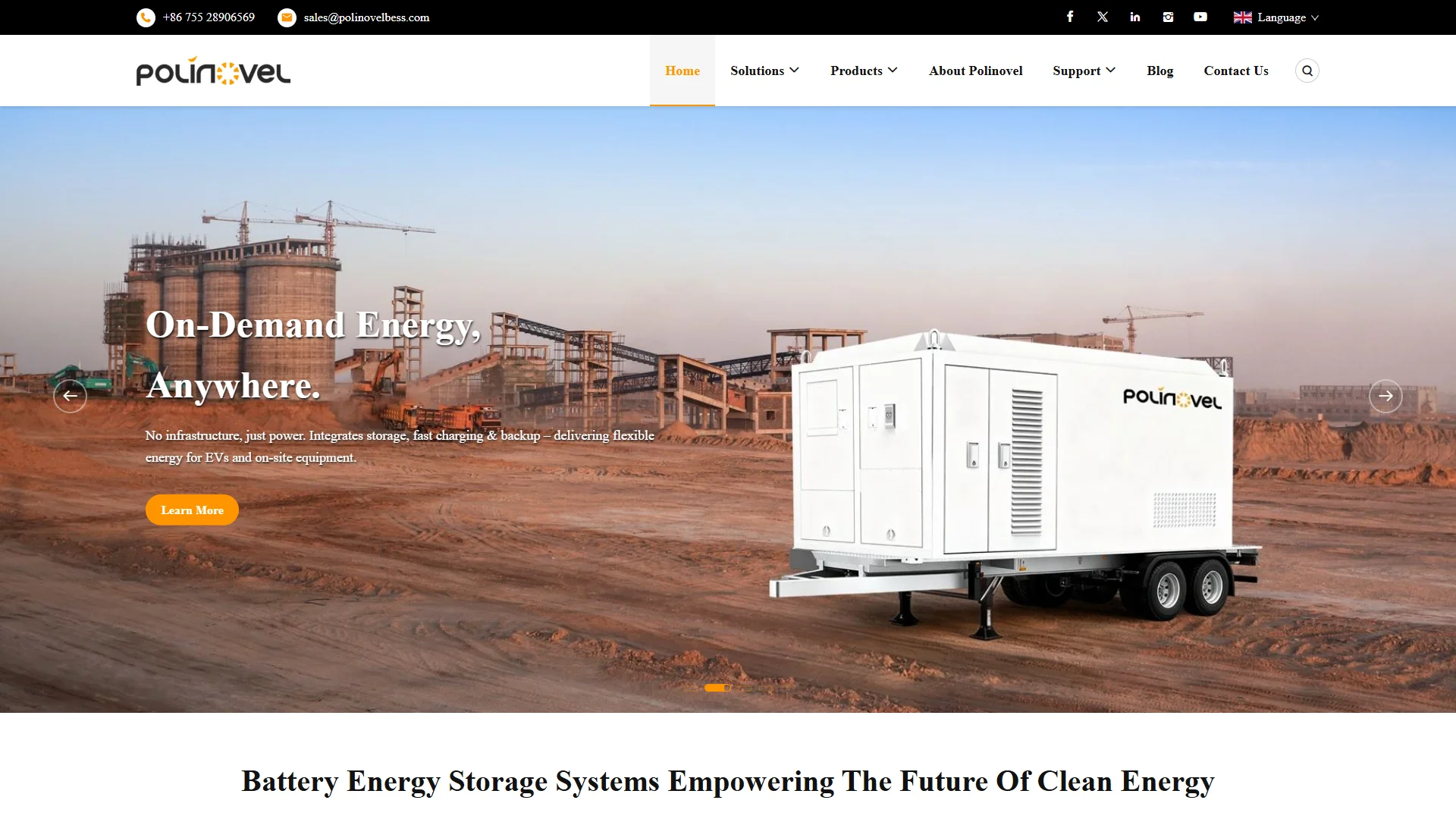
Polinovel describes itself as a Chinese battery energy-storage manufacturer serving commercial, industrial, and utility-scale applications. Its stated positioning includes end-to-end energy-storage solutions, with products covering containerized systems, outdoor cabinets, high-voltage systems, and mobile BESS.
Pros / Key Features
- Product categories span cabinet, containerized, high-voltage, and mobile storage formats.
- LiFePO4 batteries are described as offering long cycle life and thermal stability.
- Modular architecture supports rapid deployment and capacity expansion.
- Stated applications include peak shaving, backup power, grid-tied and off-grid operation, and utility-scale projects.
- The company states that relevant systems are certified to CE, UL, and IEC standards.
Use Cases / Best For
Polinovel is a strong fit for C&I facilities, substations, manufacturing sites, and utility-scale projects that need scalable storage and energy-management functions. Its modular approach may help projects that expect capacity expansion, although the specific model’s power duration, thermal design, certification scope, and local support should be verified before procurement.
4. BOOSTESS
Overview
The available BOOSTESS research identifies an Air-Cooled Battery Energy Cabinet rated at 50kW/100kWh. This gives buyers a concrete starting point for evaluating a cabinet-based system, but the supplied materials do not clearly document the company’s background, target markets, chemistry, certification portfolio, service model, or broader BESS range.
Pros / Key Features
- Public product information identifies a 50kW power rating and 100kWh energy rating.
- The cabinet uses an air-cooled design according to the available product description.
- The defined rating may simplify initial comparisons for smaller commercial or distributed-storage projects.
Use Cases / Best For
BOOSTESS is best considered for buyers evaluating an air-cooled cabinet near the stated 50kW/100kWh class. Before moving forward, purchasers should request the battery chemistry, usable energy, operating temperature range, ingress protection, fire detection and suppression provisions, cycle-life warranty, communications interfaces, certifications, installation requirements, and after-sales support terms.
5. GSL Energy
Overview
GSL Energy presents a broad LiFePO4 storage portfolio serving residential, commercial, industrial, large-scale, OEM, distributor, EPC, and system-integrator customers. Its materials describe low-voltage batteries, high-voltage systems, mini C&I equipment, and scalable configurations extending toward MWh-level applications.

Pros / Key Features
- Modular 5.12kWh, 51.2V, 100Ah LiFePO4 battery platform for distributed storage.
- High-voltage systems with stated configurations from 128kWh to 241kWh and expansion toward MWh-scale projects.
- Features include BMS control, stackable architecture, and support for CAN, RS485, and TCP/IP communications.
- Some products include Wi-Fi, Bluetooth, touch displays, and aerosol fire suppression according to the supplied materials.
- The company states certifications including UL, IEC, CE, MSDS, and UN38.3 for its systems.
Use Cases / Best For
GSL Energy is suited to homeowners, small businesses, solar distributors, installers, OEM partners, and C&I project developers. Its product range is relevant to solar self-consumption, backup power, peak shaving, microgrids, and larger modular storage installations. Buyers should distinguish between certifications and specifications for individual models rather than applying portfolio-wide claims to every product.
6. Jabil
Overview
Jabil is presented in the supplied research as an engineering, supply-chain, and manufacturing partner rather than a conventional branded BESS supplier. The company states that it helps leading brands design, build, and scale products across global markets, supported by a global supplier network and strategically located sites.
Pros / Key Features
- More than 9,000 engineers are described as supporting customers from prototype through production.
- Manufacturing models are personalized to customer production requirements.
- Capabilities include design-for-manufacturing, supply-chain management, and global production support.
- Return, refurbishment, and repair services are described as part of product-lifecycle support.
- The company reports more than 60 years of experience across multiple industries.
Use Cases / Best For
Jabil is best for BESS companies and energy-technology businesses seeking an industrialization or contract-manufacturing partner. It may be relevant when a company needs prototype development, scalable production, supply-chain risk management, or lifecycle services. The available evidence does not establish that Jabil sells a standardized, Jabil-branded BESS product, so buyers should define whether they need manufacturing services or a finished storage system.
How to Choose a BESS Brand
Start with the operating objective. A system intended for backup power has different requirements from one designed for energy arbitrage, frequency regulation, or demand-charge reduction. Evaluate the following criteria:
- Power and duration: Compare continuous power, peak power, usable energy, discharge duration, and efficiency under the intended operating profile.
- Battery chemistry and safety: Confirm chemistry, thermal-management design, fire detection, suppression, isolation, ventilation, and emergency procedures.
- System integration: Check inverter compatibility, energy-management software, grid controls, communications protocols, metering, and cybersecurity provisions.
- Certifications: Verify certifications for the exact model and destination market. Portfolio-level statements should not replace model-specific documentation.
- Warranty and degradation: Review throughput limits, retained-capacity guarantees, operating conditions, exclusions, and replacement responsibilities.
- Environment and installation: Consider temperature, humidity, altitude, salt exposure, dust, noise, enclosure rating, footprint, and access for maintenance.
- Service capability: Confirm commissioning, remote monitoring, spare parts, response times, software updates, training, and end-of-life handling.
- Commercial fit: Compare total installed cost, expected savings, financing, delivery schedule, grid-connection requirements, and the supplier’s experience with similar projects.
Final Verdict
Jinkosolar takes the top position for buyers seeking a major solar-sector brand to evaluate for renewable-generation and storage projects, although the exact BESS model and regional offering must be verified. Polinovel is more directly positioned around commercial, industrial, and utility BESS products. GSL Energy offers a broad modular LiFePO4 range spanning residential through larger applications. BOOSTESS is relevant for a defined 50kW/100kWh air-cooled cabinet evaluation. Aikosolar is primarily supported here as a PV-module option for solar-plus-storage planning, while Jabil is better understood as an engineering and manufacturing partner than as a standardized BESS brand. The best choice depends on documented technical fit, safety compliance, service capability, and project economics.
FAQs
1. What does BESS mean?
BESS means battery energy storage system. It normally includes battery cells or modules, a battery-management system, power-conversion equipment, controls, thermal management, safety equipment, and monitoring interfaces.
2. Is a solar-panel brand automatically a BESS brand?
No. A solar-panel manufacturer may offer storage, partner with a storage supplier, or focus only on photovoltaic generation. Buyers should confirm the exact BESS product, battery chemistry, system rating, certifications, warranty, and service arrangements.
3. Which information should be requested before ordering a BESS?
Request a model-specific datasheet, single-line diagram, usable-energy and power ratings, efficiency data, safety documentation, certification records, warranty, degradation assumptions, installation requirements, communications details, commissioning plan, maintenance terms, and local support contacts.
