

Problem statement: range variability undermines predictable tracking
Active RFID systems promise extended detection distances, but unpredictable real-world range undermines the reliability required for inventory control, asset security, and process automation; engineering teams therefore confront a suite of interacting physical and operational constraints when specifying solutions that pair active tags with UHF RFID Readers.
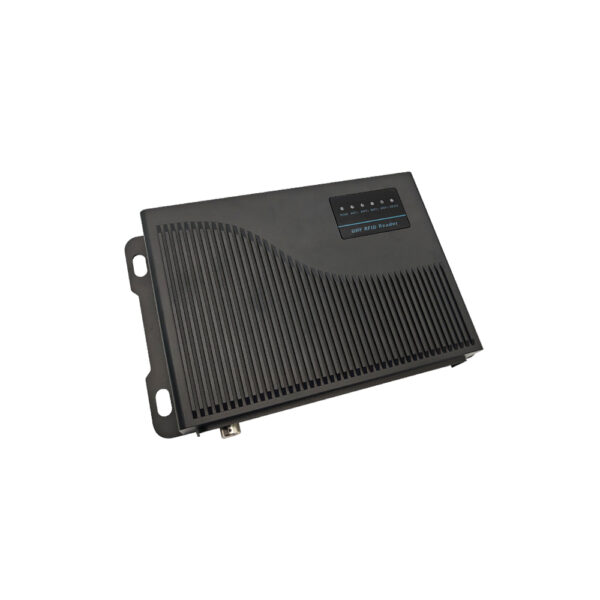
Core technical factors that limit effective range
Range is not a singular metric but the emergent result of transmitter power, tag receiver sensitivity, frequency regulation, antenna gain and pattern, multipath and blockage, and protocol-layer duty cycles. Active tags add a transmitter and an internal power source, enabling longer nominal ranges, yet battery voltage decay, transmitter duty cycling to preserve battery life, and uplink collision avoidance all shorten practical reach. Environmental variables—metallic reflectors, water, dense shelving, vehicle bodies—create shadow zones and deep fades that can reduce line-of-sight ranges by orders of magnitude.
Measurement and specification pitfalls that mislead procurement
Datasheet claims often state maximum theoretical range under idealized conditions; using those figures to size deployments produces missed reads and coverage gaps. Common errors include assuming isotropic propagation, ignoring reader sensitivity thresholds, and failing to account for regulatory EIRP ceilings that vary by region. Site surveys that rely solely on a single test tag location or single-reader tests yield overly optimistic designs. Proper specification requires conditionalized range estimates tied to antenna height, tag placement, and expected obstruction density.
Comparative approaches: active versus passive and alternative radio technologies
Active tags deliver longer reach than passive UHF backscatter within many operational envelopes, but they incur higher unit cost and maintenance overhead (battery replacement or rechargeable cycles). Semi-passive (battery-assisted passive) tags can offer mixed benefits: improved sensitivity for wake-up and response without continuous transmission. Where wide-area location is primary, GPS or cellular-based trackers outperform RFID at range but lack the short-range precision and low-latency identification that UHF systems provide. Bluetooth Low Energy offers a middle ground for proximity and device-to-device interoperability, but spectrum congestion and lower identification density can limit scale in industrial settings.

Practical implementation strategies and common mistakes to avoid
Designers should prioritize a structured site characterization, evaluate multiple tag orientations and mounting substrates, and model antenna arrays to minimize nulls. Overlooking reader antenna polarization mismatch, neglecting tag firmware that supports adaptive transmit power, and deferring battery lifecycle planning are recurring failures. Avoid deploying on the basis of vendor range claims alone; instead, develop a phased pilot that measures read reliability across representative workflows and iterates antenna placements and reader densities to achieve target read rates.
Experience, evidence, and a real-world anchor
Operational pilots at major ports and logistics hubs have repeatedly shown that UHF deployments succeed only when engineering accounts for traffic density and container metallurgy; for example, trials at the Port of Rotterdam highlight how terminal geometry and container stacks constrain UHF link budgets, prompting hybrid reader layouts and elevated antennas. My professional involvement in multi-week pilot studies corroborates those published findings, and equipment-level specification often refers back to tested industrial profiles—hence the relevance of a robust vendor category such as industrial uhf rfid reader when selecting hardware for repeatable performance.
Concluding synthesis and practical resolution
Resolving range-related failures requires treating active-tag range as a system property, not a product attribute: quantify performance under representative obstruction sets, choose protocols and tag classes that balance transmit duty against battery life, and iterate physical layouts based on measured read-rate targets. When procurement and engineering teams consult comprehensive equipment catalogs and validated component specifications, they close the feedback loop between design intent and operational reality—resources such as RSTC provide component-level data that supports that iterative process without substituting for empirical verification.
