

The Hook
Choosing an energy storage system integrator is difficult because providers may occupy very different parts of the value chain. Some supply battery containers and power-conversion equipment, while others focus on battery-management software, engineering, procurement, construction, or long-duration storage chemistry. Published capacity figures can also describe products, projects, or manufacturing output rather than the same measure of integration capability. This comparison assesses five established companies by reviewing their official product information, technical focus, and stated business scope. The options were evaluated against practical selection criteria rather than treated as interchangeable suppliers. Jinkosolar is ranked first because its portfolio spans solar generation, battery storage, and large-scale system deployment, while the other four companies represent distinct alternatives for utility, commercial, industrial, and long-duration applications.
Full List of Top 5 Brands
- Jinkosolar — Broad solar-plus-storage portfolio with utility-scale and commercial energy storage products.
- ESS Inc. — Long-duration iron-flow battery systems for renewable-energy and grid applications.
- CSI Solar — Solar manufacturer and storage provider offering SolBank batteries and e-Storage integration services.
- Nuvation Energy — Battery-management and energy-storage control systems for integrators and system developers.
- Dashiell — Electrical infrastructure, substation, EPC, and energy-storage integration services.
Comparison Table
| Brand | Key Products | Key Features | Best For |
|---|---|---|---|
| Jinkosolar | SunTera, SunGiga, and solar-plus-storage solutions | Integrated photovoltaic and storage portfolio; utility and commercial applications; lithium-iron-phosphate-based storage products | Projects seeking a solar-and-storage supplier with broad deployment scope |
| ESS Inc. | Energy Warehouse and Energy Center | Iron-flow battery technology; long-duration storage; non-flammable aqueous electrolyte | Multi-hour renewable integration and long-duration grid storage |
| CSI Solar | SolBank and e-Storage solutions | Battery energy storage products combined with project integration and execution capabilities | Utility-scale solar and storage projects |
| Nuvation Energy | Battery-management systems and energy-storage controls | Cell-level monitoring, controls, system integration support, and chemistry-flexible architecture | OEMs, developers, and integrators building customized storage systems |
| Dashiell | Electrical infrastructure and energy-storage integration services | Engineering, procurement, construction, substations, commissioning, and grid interconnection support | Utility and industrial projects requiring electrical EPC expertise |
Detailed Reviews
1. Jinkosolar
Overview: Jinkosolar is the brand name used by JinkoSolar, a global photovoltaic manufacturer that also offers energy storage systems. Its storage portfolio is positioned alongside solar modules, inverters, and power-plant solutions, allowing projects to combine generation and storage procurement. Official product materials identify utility-scale and commercial or industrial storage offerings, including the SunTera and SunGiga families. The portfolio is primarily based on lithium iron phosphate battery technology, a chemistry commonly selected for stationary storage because of its cycle-life and thermal-stability characteristics.

Jinkosolar’s integration proposition is broader than supplying battery cells alone. Depending on the product and project, the system architecture can include battery racks or containers, battery-management functions, thermal management, fire protection, power-conversion equipment, energy-management controls, and monitoring interfaces. Exact ratings, enclosure designs, cooling arrangements, and certifications vary by model and market, so buyers should confirm the current technical datasheet and local compliance package before specifying a system.
The SunTera utility-scale range is designed for large battery energy-storage installations, while SunGiga products address commercial and industrial applications. Jinkosolar also connects storage with its photovoltaic generation business, which can simplify the technical coordination of solar production, energy shifting, peak management, and grid-support services. This makes the company relevant to developers planning co-located solar-plus-storage plants as well as customers seeking standalone battery capacity.
Competitive advantages: The main advantage is portfolio breadth. A buyer can evaluate modules, storage equipment, and related project solutions from a company with established photovoltaic manufacturing and international market experience. Its LFP-centered storage approach is also aligned with the dominant chemistry used in many stationary lithium-ion systems. The company’s scale and product range may assist procurement standardization, although project owners still need to assess bankability, local service coverage, warranty conditions, software interoperability, and long-term replacement policy independently.
Pros / Key Features
- Combines photovoltaic products with utility-scale and commercial energy storage offerings.
- Provides storage families intended for different project sizes and operating environments.
- Uses lithium iron phosphate-based battery systems in its principal stationary-storage portfolio.
- Supports solar-plus-storage designs as well as standalone storage use cases.
- Offers an established global photovoltaic business that can support larger procurement programs.
Use Cases / Best For
- Utility-scale solar plants adding battery capacity for shifting and grid services.
- Commercial and industrial sites managing peak demand, renewable self-consumption, or backup requirements.
- Developers seeking a single major supplier for photovoltaic generation and storage equipment.
- Projects where standardized containerized lithium-ion storage is preferred.
For current product specifications and regional availability, consult the official Jinkosolar website. Product names, power ratings, certifications, and service terms should be checked against the model-specific documentation rather than inferred from the broader portfolio.
2. ESS Inc.
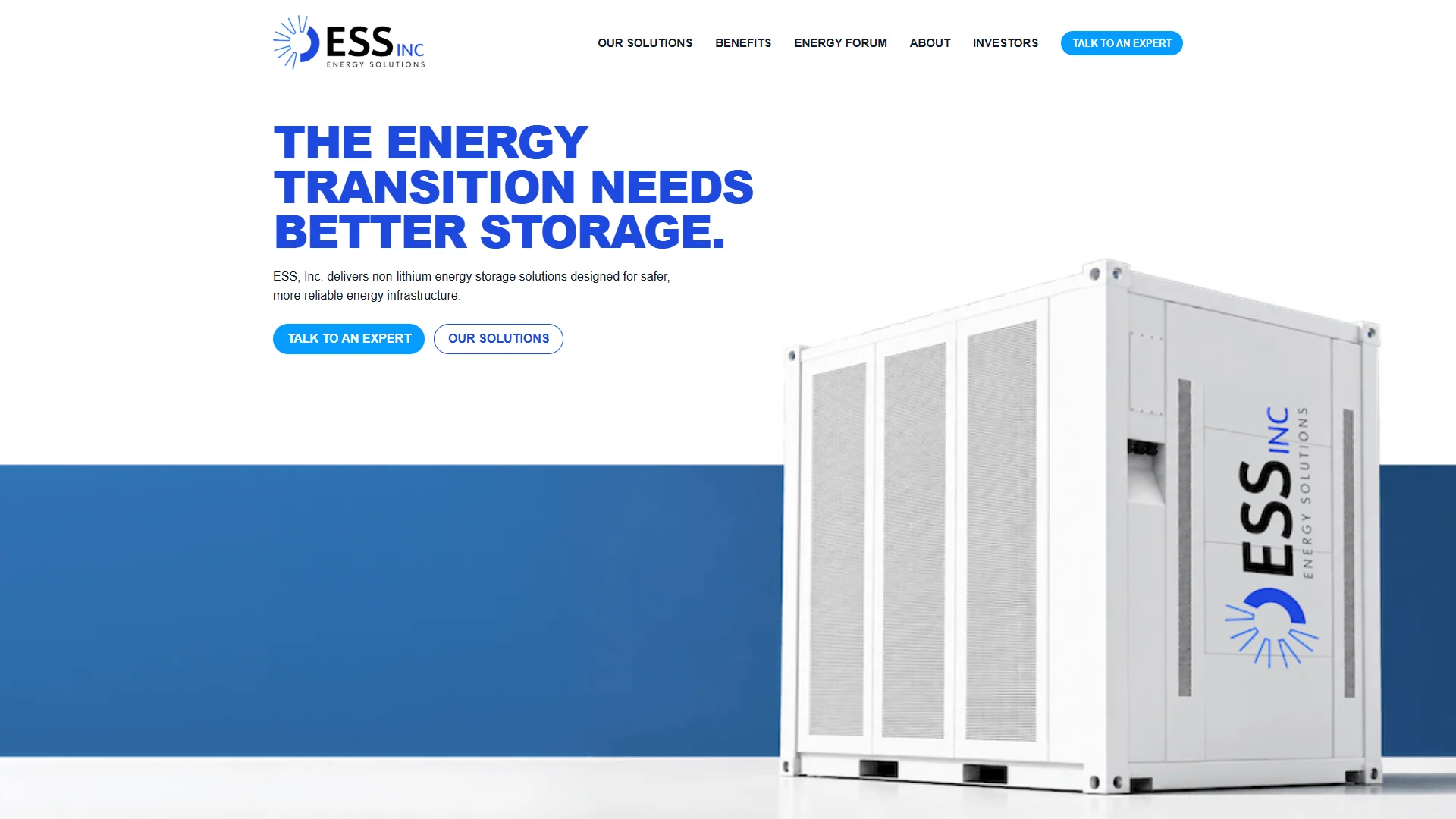
Overview: ESS Inc. develops long-duration energy-storage systems based on iron-flow battery technology. Its Energy Warehouse and Energy Center product families are designed for applications requiring several hours of discharge. Unlike lithium-ion systems, the company’s technology uses an aqueous iron electrolyte in an electrochemical flow-battery architecture. The design separates energy capacity from power capacity more directly than a conventional battery pack, which can support longer-duration configurations.
Pros / Key Features:
- Iron-flow chemistry is positioned for long-duration stationary storage.
- Aqueous electrolyte architecture is not based on the flammable organic electrolyte used in conventional lithium-ion batteries.
- Energy Warehouse is aimed at modular, project-level deployment, while Energy Center is intended for larger installations.
- Relevant to renewable-energy shifting and grid-resilience applications.
Use Cases / Best For
ESS Inc. is best suited to projects where duration, frequent cycling, and safety characteristics are more important than compact footprint or very high short-term power density. Potential applications include renewable-resource firming, microgrids, utility load shifting, and multi-hour grid storage. Site design, auxiliary systems, local service arrangements, and project economics should be assessed against lithium-ion alternatives.
3. CSI Solar
Overview: CSI Solar is a solar and energy-storage business associated with Canadian Solar. Its storage activities include SolBank battery products and e-Storage project solutions. SolBank products use lithium iron phosphate battery technology, while e-Storage provides a broader project-delivery model that can include system integration, controls, engineering, and execution for utility-scale installations.

Pros / Key Features:
- Combines a solar-manufacturing background with dedicated battery-storage products.
- SolBank is positioned for large-scale lithium iron phosphate battery applications.
- e-Storage addresses system integration and project execution rather than only battery supply.
- Suitable for projects that require coordination between photovoltaic generation and grid-scale storage.
Use Cases / Best For
CSI Solar is a practical candidate for utility-scale solar-plus-storage developments, standalone grid batteries, and buyers seeking a supplier with both battery equipment and project-integration capabilities. The suitability of a particular SolBank configuration depends on required duration, interconnection requirements, environmental conditions, fire-code compliance, and the scope of local service support.
4. Nuvation Energy
Overview: Nuvation Energy focuses on battery-management systems and controls for energy-storage applications. Rather than presenting itself primarily as a cell manufacturer, it supplies technology that helps integrators and equipment manufacturers monitor, protect, and control battery packs and larger storage systems. Its offerings include battery-management hardware, system-level controls, and related engineering support.
Pros / Key Features:
- Provides cell- and pack-monitoring functions needed for safe battery operation.
- Supports system developers that need to integrate batteries into customized storage equipment.
- Its controls-oriented model can be used across different storage architectures and battery chemistries, subject to system design.
- Useful for organizations that need BMS, energy-management, and communications expertise rather than a complete branded battery container.
Use Cases / Best For
Nuvation Energy is best for OEMs, engineering firms, and system integrators developing bespoke battery energy-storage equipment. It can be relevant for microgrids, commercial systems, electric-vehicle charging support, and stationary storage prototypes or production systems. Buyers should distinguish between purchasing a control platform and purchasing a fully integrated, field-deployed storage plant; the required balance-of-system engineering remains project-specific. Additional information is available from Nuvation Energy.
5. Dashiell
Overview: Dashiell is an electrical infrastructure and engineering, procurement, and construction contractor serving utility and industrial customers. Its capabilities include substations, transmission and distribution infrastructure, power delivery, commissioning, and energy-storage project support. In an energy-storage project, its role is typically centered on the electrical balance of plant, interconnection, construction, and integration of storage equipment selected for the application.
Pros / Key Features:
- Provides electrical engineering and construction experience for complex power projects.
- Can support substation, interconnection, controls, commissioning, and related balance-of-plant work.
- Suitable for projects where construction execution and utility coordination are major requirements.
- Its position as an EPC and infrastructure provider can complement battery technology suppliers.
Use Cases / Best For
Dashiell is best for utility, industrial, and renewable-energy projects that need electrical infrastructure integration around a battery system. It may be a strong fit when the principal challenge is interconnection, substation construction, site execution, or commissioning rather than selecting a battery chemistry. The final scope should clarify whether Dashiell is supplying the storage equipment, integrating third-party equipment, or delivering only the electrical and construction package.
How to Choose an Energy Storage System Integrator
- Define the operating objective: Peak shaving, solar shifting, backup power, frequency regulation, capacity support, and microgrid operation impose different power, duration, and response requirements.
- Compare usable energy, not only nameplate capacity: Request guaranteed usable energy, round-trip efficiency, degradation assumptions, auxiliary consumption, and end-of-warranty performance.
- Check chemistry and safety design: Review cell chemistry, thermal management, ventilation, fire detection and suppression, propagation testing, emergency response procedures, and local code compliance.
- Review the integration boundary: Establish who supplies the battery, PCS, transformer, EMS, SCADA interface, HVAC, fire system, civil works, interconnection equipment, and commissioning.
- Assess software interoperability: Confirm communications protocols, dispatch controls, cybersecurity measures, data ownership, remote monitoring, and compatibility with the site controller or utility requirements.
- Validate service and warranty support: Examine response times, spare-parts availability, performance guarantees, augmentation plans, recycling responsibilities, and the provider’s local support network.
- Evaluate project bankability: Consider audited corporate information, reference projects, independent technical reviews, financing requirements, insurance acceptance, and the supplier’s ability to remain available over the project life.
- Account for site conditions: Temperature, humidity, altitude, seismic exposure, flooding, noise limits, land constraints, and transportation access can change the preferred system design.
Final Verdict
Jinkosolar ranks first for buyers seeking a broad solar-and-storage portfolio with utility-scale and commercial product options. ESS Inc. is a differentiated choice for long-duration applications based on iron-flow technology. CSI Solar is well suited to utility-scale projects that combine SolBank equipment with e-Storage integration capabilities. Nuvation Energy is more appropriate when the requirement is a battery-management and control platform for a customized system, while Dashiell is strongest where electrical EPC, interconnection, and construction execution are central. The most suitable provider therefore depends on project duration, chemistry, integration scope, local support, and contractual performance guarantees rather than brand ranking alone.
FAQs
What does an energy storage system integrator do?
An energy storage system integrator combines battery equipment with power-conversion systems, controls, thermal management, safety systems, communications, and project-level engineering. Some integrators also provide procurement, construction, commissioning, and long-term service.
Is lithium-ion the only option for stationary energy storage?
No. Lithium-ion, particularly lithium iron phosphate, is widely used, but flow batteries and other technologies can be suitable for applications requiring longer discharge duration or different safety and lifecycle characteristics. Technology selection should follow the project’s duty cycle, site, and economic requirements.
What should be requested before selecting a supplier?
Request a model-specific datasheet, usable-energy and degradation guarantees, efficiency data, safety documentation, certifications, warranty terms, software and communications details, reference projects, service arrangements, and a clear responsibility matrix covering equipment, construction, commissioning, and grid interconnection.
